_edited_edite.png)

Week 6
Updated: Apr 30
This week, our primary focus was to finalize an improved edit that fixed the pacing of our shots, followed by refining elements in our shots.
Feedback
Trim down shots 1 and 2
Give shots 5B and 6 more frames for sims to settle
Cut the camera ease in and out on shot 7
Warm up the lighting for more dreamy feeling
Balance out the key to fill ratio
Tilt the lights in shot 1 for more contrast
Ensure outside of window is brightest spot in shot
Consistent color grading across all shots
Keep refining cloth sims
Vellum post process on cloth
After receiving feedback from our mentors, we agreed as a team that the edit needed further refinement, particularly in terms of timing, before continuing to polish individual shots. We decided on specific adjustments that would improve the pacing and overall flow of our shots.
Shot 1 slower weaving
Shot 2 a little faster embroidery motion
Shot 4 end sooner during fabric fall
Shot 5B pillows needs more frames at the end to settle
Shot 6 comforter needs more frames at the end to settle
Shot 7 kill the ease in ease out and slightly slower
Based on those notes, Mia revisited our current renders and created a revised cut that we felt stronger about. She also defined a precise frame range for each shot to ensure that we only render what is necessary and avoid spending time on frames that will ultimately be cut.
Shot 1: 92 - 172 (80 frames)
Shot 2: 34-108 (74 frames)
Shot 4: 0-57 (57 frames)
Shot 5A: 8-34 (26 frames)
Shot 5B: 15 - 89 (74 frames)
Shot 6: 24 - 110 (86 frames)
Shot 7: 0-119 (119 frames)
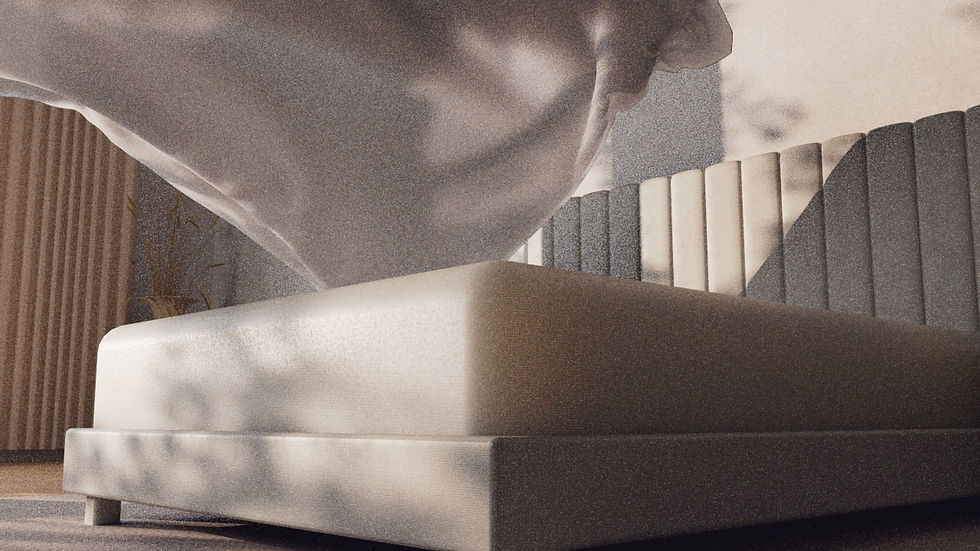
I focused on improving the shadow quality across several shots. For Shots 4 and 5A, I softened the shadows to better convey the softness of the bedding. Since our void set provides minimal environmental cues, subtle lighting adjustments like this help in shaping the mood of the shot.


One key point from our mentor’s feedback was the absence of shadows from the trees composited outside the window. Initially, I experimented with a variety of gobos applied to the window light to simulate natural tree shadows. While technically they worked, the result did not match the aesthetic we were aiming for and decided to try an alternate method.

Zach used one of the trees in Unreal Engine to export an image sequence with an alpha channel. Ella then helped me apply the image sequence as an alpha texture on an image plane positioned in front of the window. After adjusting the light placement and refining the position of the image plane, we were able to achieve softer, more natural-looking shadows that better supported the mood we have for the shot. Additionally, with the image sequence the shadows sway with a slight breeze providing an additional element of visual interest.

Ultimately, the gobo remains a work in progress, particularly in Shot 6, where the camera’s close proximity to the bed shows significantly more detail than in Shot 7. By changing the position of the image plane relative to the spotlight and window, I am adjusting the sharpness of the shadows being cast.


Comments